In 2026, renting in Malta costs roughly €708 a month for a studio, €868 for a one-bedroom and €1,180 for a two-bedroom, averaging the 33 areas tracked here equally. The central coast around Sliema and St Julian's runs 40 to 60 percent above those means, while Gozo and the deep south sit well below them. The tool above breaks the averages down area by area so you can see what your own budget actually rents.
The 2026 numbers behind the explorer
Malta does not publish an official rent table by area and bedroom count, so the honest answer is a range rather than a single figure. The triangulated 2026 market-wide typical, weighted toward the central areas where most of the stock actually sits, is about €800 for a studio, €950 for a one-bedroom, €1,250 for a two-bedroom and €1,550 for a three-bedroom. Average the 33 tracked areas equally instead, as the summary box above does, and the figures land 10 percent or so lower, because a quiet village counts as much as Sliema in that mean. Where you land inside those ranges depends almost entirely on the postcode.
Asking rents rose again in 2025, up roughly 10-20% depending on region (KPMG/MDA), and are still climbing into 2026 but decelerating. 60.2% of all rental listings now ask above €1,200/month, up from 55.5% a year earlier. The authoritative source here is the KPMG and MDA property market report, which puts the Grand Harbour region top of the table for average apartment rent and the South of Malta at the bottom. That regional gap is the single biggest lever on your monthly cost, bigger than the number of bedrooms in many cases.
This page carries the numbers and how to read them. The process side, contracts, deposits, Housing Authority registration, viewings and your rights as a tenant, is a different job and lives in the renting in Malta guide.
Rent is only part of a Malta budget. To see the whole picture, pair this with the cost of living calculator and the cost of living guide, and if you are weighing a job offer, the salary calculator turns a gross salary into the take-home pay these rents come out of.
The full dataset, area by area
The table below is the full dataset, every area and every apartment size, so you can scan it without touching the filters. Figures are monthly long-let ranges. A "room" column is shown where renting a single room in a shared flat is a genuine market.
| Area | Studio | 1-bedroom | 2-bedroom | 3-bedroom |
|---|---|---|---|---|
| Central coast | ||||
| Sliema | €850–€1,200 | €1,000–€1,500 | €1,400–€2,200 | €1,800–€2,900 |
| St Julian's | €900–€1,300 | €1,050–€1,600 | €1,350–€2,400 | €1,900–€3,400 |
| Swieqi | €750–€1,000 | €950–€1,400 | €1,150–€1,900 | €1,500–€2,400 |
| Pembroke | €750–€1,050 | €1,000–€1,400 | €1,400–€2,000 | €1,800–€2,800 |
| Gzira | €700–€950 | €800–€1,200 | €1,100–€1,600 | €1,400–€2,000 |
| Msida | €680–€950 | €750–€1,100 | €1,000–€1,500 | €1,300–€2,000 |
| Ta' Xbiex | €700–€950 | €900–€1,300 | €1,150–€1,800 | €1,500–€2,600 |
| Grand Harbour | ||||
| Valletta | €900–€1,250 | €1,000–€1,600 | €1,400–€2,200 | €1,800–€3,000 |
| Three Cities (Birgu, Senglea, Cospicua) | €700–€1,000 | €900–€1,350 | €1,150–€1,900 | €1,500–€2,600 |
| Inner Harbour (Ħamrun, Qormi, Marsa, Santa Venera) | €500–€750 | €650–€950 | €850–€1,200 | €1,100–€1,600 |
| Floriana & Pietà | €600–€900 | €750–€1,150 | €1,000–€1,500 | €1,300–€1,900 |
| Southern Harbour (Żabbar, Kalkara, Xgħajra) | €500–€750 | €600–€950 | €800–€1,200 | €1,050–€1,550 |
| Central inland | ||||
| San Ġwann | €650–€900 | €650–€950 | €900–€1,200 | €1,150–€1,600 |
| Mosta | €600–€950 | €650–€950 | €900–€1,400 | €1,200–€1,700 |
| Birkirkara | €600–€800 | €700–€950 | €950–€1,500 | €1,300–€2,000 |
| Naxxar | €550–€800 | €650–€950 | €900–€1,300 | €1,150–€1,700 |
| Three Villages (Attard, Balzan, Lija) | €700–€950 | €800–€1,150 | €1,050–€1,500 | €1,400–€2,400 |
| Iklin & Għargħur | €600–€850 | €700–€1,050 | €950–€1,350 | €1,250–€1,800 |
| West | ||||
| West Villages (Siġġiewi, Dingli, Żebbuġ) | €500–€700 | €600–€900 | €800–€1,150 | €1,100–€1,600 |
| Mdina, Rabat & Mtarfa | €550–€800 | €650–€1,000 | €900–€1,300 | €1,200–€1,800 |
| North | ||||
| St Paul's Bay / Bugibba / Qawra | €600–€850 | €600–€1,100 | €800–€1,500 | €1,000–€2,000 |
| Mellieħa | €450–€700 | €550–€950 | €750–€1,200 | €1,000–€1,600 |
| South | ||||
| Marsaskala | €550–€800 | €650–€950 | €850–€1,250 | €1,100–€1,700 |
| Deep South (Fgura, Paola, Żejtun) | €500–€750 | €550–€850 | €750–€1,150 | €950–€1,500 |
| Southwest Villages (Żurrieq, Qrendi, Mqabba, Kirkop, Safi) | €450–€650 | €550–€800 | €700–€1,000 | €950–€1,350 |
| Airport Belt (Birżebbuġa, Gudja, Għaxaq, Luqa, Santa Luċija) | €450–€700 | €550–€850 | €750–€1,100 | €1,000–€1,450 |
| Gozo | ||||
| Victoria (Gozo) | €400–€600 | €500–€750 | €700–€1,100 | €900–€1,300 |
| Marsalforn (Gozo) | €450–€650 | €550–€850 | €750–€1,200 | €950–€1,400 |
| Xlendi (Gozo) | €450–€650 | €550–€850 | €750–€1,150 | €950–€1,400 |
| Nadur & Qala (Gozo) | €400–€600 | €500–€800 | €700–€1,150 | €900–€1,450 |
| Xagħra (Gozo) | €400–€600 | €500–€800 | €700–€1,100 | €900–€1,350 |
| Central Gozo Villages (Għajnsielem, Xewkija, Kerċem) | €400–€600 | €500–€750 | €700–€1,050 | €900–€1,300 |
| Rural West Gozo (Għarb, Għasri, San Lawrenz, Sannat) | €400–€600 | €500–€800 | €700–€1,100 | €950–€1,400 |
Renting a room in a shared flat is the cheapest way in, and the best-documented markets are the student and young-professional zones: St Julian's (€500–€800), Gzira (€420–€650), Msida (€400–€600), Ta' Xbiex (€420–€650), Birkirkara (€450–€750), St Paul's Bay / Bugibba / Qawra (€350–€550). Prefer a whole place? The interactive neighborhood map plots every area above by vibe or by rent, and the where to live in Malta guide sorts them by who each one suits.
What €1,000 a month rents across Malta
The same budget, translated across the island, is the clearest way I know to show how much the postcode costs. In Sliema or St Julian's it gets you a studio, or the very bottom of the one-bedroom market in an older building off the seafront. In Gzira or Msida it is a decent mid-range one-bedroom, the standard young-professional setup. In Birkirkara or Mosta, a good one-bedroom or an entry two-bedroom with a proper kitchen. In Marsaskala or the deep south, a solid two-bedroom, often with outdoor space. In Victoria on Gozo, a two-bedroom near the top of the range, or a three-bedroom if you shop patiently.
Same euro, one island, five different lives. This is why I push every new arrival to decide what they want from Malta before deciding what to pay for it. The interactive neighborhood map lays those trade-offs out visually.
What you can afford on a Maltese salary
Numbers without income context are decoration. The standard affordability line is rent at 30-35% of net income, and Maltese salaries make that a tight fit: on a typical €1,500-1,800 net month (the full picture is in the average salary breakdown), the sustainable rent band is €450-630. That single figure explains why the flat-share market here is so deep and why couples dominate the one-bedroom market. Two average salaries carry a €1,100 two-bedroom comfortably; one average salary alone in Sliema does not work without pain.
Three worked examples on mid-2026 figures. A single arrival on €1,600 net: a €500 room in Gzira with bills included leaves €1,100 for everything else, comfortable; upgrading to a €900 Msida one-bedroom leaves €700 before utilities, groceries or a single Cisk on a terrace, which works tightly with no savings margin. A couple on €3,200 net combined: a €1,200 two-bedroom in Gzira or San Ġwann sits at 37% of net, workable, with a spare room that halves itself into an office; the same couple in a €1,700 Sliema two-bed is at 53% and will feel it every month. A family of four on €4,000 net: a €1,400 three-bedroom in Mosta or Naxxar is 35% of income, in a town built for exactly this life, near the schools, against €2,400+ for the corridor equivalent.
To turn rent into a full monthly budget, pair this with the cost of living calculator, and if you are weighing a job offer, the salary calculator turns a gross figure into the take-home pay these rents come out of.
Why the listings you see cost more than this table
Portals show asking prices. Tenants sign for less. The gap runs 15-20% at the renovated top end of Valletta and narrows elsewhere, so a flat that has been listed for more than two or three weeks has a landlord who already knows this.
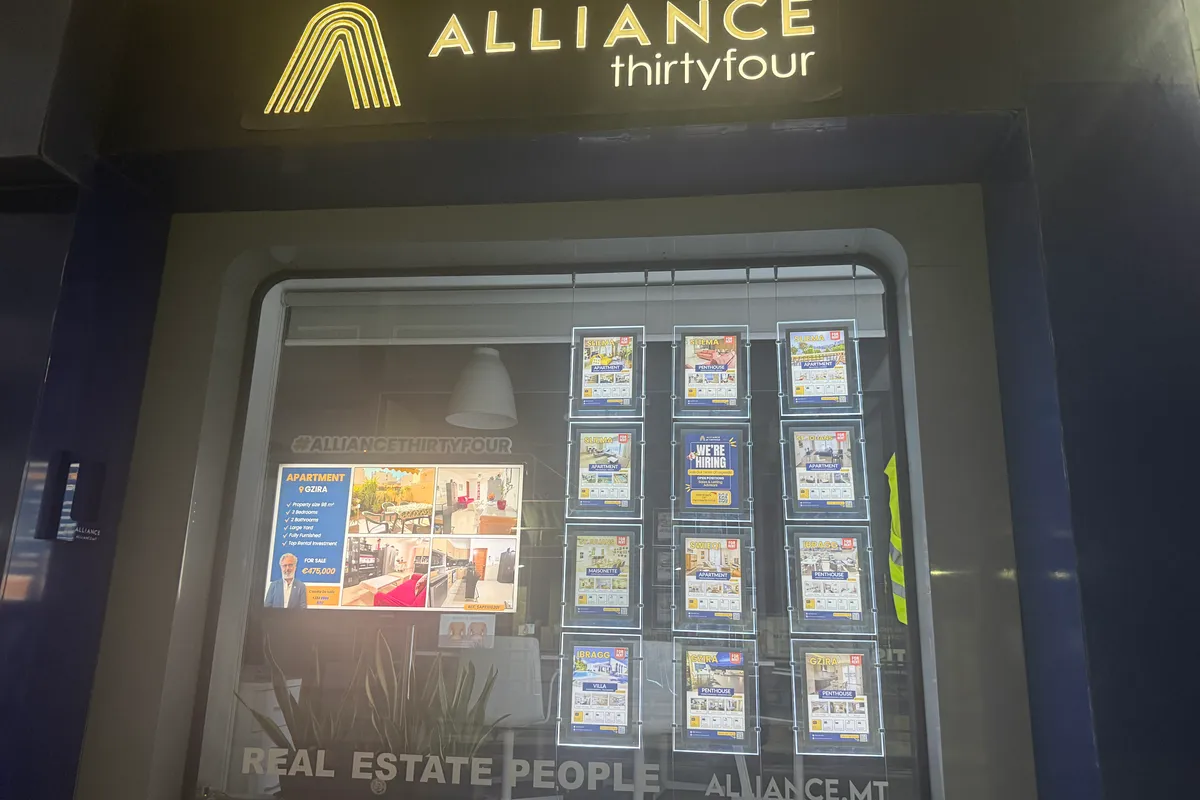
The bigger distortion is seasonal inventory. In St Paul's Bay, Mellieħa, Marsalforn and Xlendi, a large share of what appears on the portals is holiday-let stock wearing a long-let price tag. Ask explicitly for a 12-month registered lease and half of that "market" disappears, along with its price level. A two-bedroom in St Paul's Bay asking much above €1,100 is usually seasonal inventory in disguise.
Timing does the rest. Signing between October and March is worth 5-15% depending on the area, strongest in the north and the resort villages where landlords are staring down a winter void. And the best-priced stock in older buildings never reaches the portals at all: it moves through "To Let" signs, notice boards and word of mouth. I pay under the published range for my own area on a normal registered contract in St Julian's, and nothing about that is exceptional. It is simply what the unlisted market looks like. How to actually run that conversation, what to check at a viewing and what documents to have ready, is in the renting guide.
What the rent does not include
Utilities are almost never included in a long let. Budget around €100 a month for one person and €145 for a couple at the correct tariff, more once the summer air conditioning starts, and check that you are billed at ARMS' cheaper Residential rate rather than the Domestic one: it is a 30% difference and it catches a shocking number of tenants. Upfront, expect one month's deposit plus, if an agent is involved, a letting fee of half a month's rent plus 18% VAT. On a €1,200 apartment that means having €2,400-3,600 available before you get the keys.
"Bills included" offers exist and are standard in room shares, where they are fine. On a whole flat, a flat monthly figure for bills usually prices in a margin for the landlord; the real ARMS bill is cheaper most of the year. The full mechanics, which form to sign to get onto the Residential rate and what to do when a landlord refuses, are in the renting in Malta guide.
Why rent in Malta is this high
The structure of the market points one way. On the demand side, Malta has spent a decade importing workers faster than it builds homes for them: foreign nationals now make up 38.6% of the workforce, nearly all of them rent, and they concentrate in a handful of coastal towns. On the supply side, roughly three-quarters of residents own their home, so the rental market is a thin slice of the housing stock fought over by everyone who arrived after property got expensive. Add the holiday-let economy competing for the same coastal apartments every summer, and no rent control on new contracts (the 5% annual cap under the lease law applies within longer tenancies and renewals, not to a fresh lease), and you get a market that reprices upward with every wave of arrivals.
It was not always like this. Rents fell visibly in 2020-2021 when tourism and the language students vanished, recovered through 2022-2023 as the workforce inflow resumed, then accelerated hard. If you last checked Malta rents in 2024, add a fifth to your mental figures and you will be close to the table above.
Looking forward, hedged as any forecast should be: expect low-single-digit increases in the corridor and flat-to-slightly-up prices in the areas nobody fights over, with the usual seasonal sawtooth on top. What has changed at the top of the market is that new supply keeps arriving in the corridor towers, holiday-let yields have softened, and landlords with empty autumn flats negotiate in a way 2022 landlords did not.
How this data is put together
These are not scraped Numbeo averages. Each area range is triangulated for 2026 from at least two independent market sources and anchored toward realistic achieved rents, with seasonal holiday-let and trophy-luxury asking prices trimmed off the top. Where a market is thin or bimodal, the area is flagged "Estimated" rather than dressed up as precise. The main sources:
- KPMG / MDA Construction Industry & Property Market Report 2025: Authoritative macro trend + regional apartment averages (Grand Harbour highest €1,678, South lowest €1,228). No per-bedroom table.
- FreeMalta rent-by-area guide 2026: Most granular per-area, per-bedroom aggregator; blends Housing Authority registered rents with asking.
- Global Property Guide (Malta): Median rents by area, achieved-side anchor.
- propertymarket.com.mt: Live asking rents (skew high).
- QuickLets: Live asking rents + room shares.
- Investropa – Updated Rents in Malta (Jan 2026): Per-area asking + modeled figures; used to re-verify Swieqi and Mellieħa (July 2026).
- MyRent rental-cost guide: Agency asking ranges by size; used to anchor Marsaskala 2-bed (July 2026).
The dataset was last refreshed on 2026-07-14 and is reviewed each quarter. Rents move, and portals show asking prices rather than what tenants actually sign for, so treat every figure as an indicative starting point for your own search, not a quote.
So where should you actually rent?
If I were landing in Malta today on a normal salary, I would take a room in Gzira or Msida for six months, learn the island, then sign a one-year lease in whichever of San Ġwann, Gzira or Marsaskala fits my life, in late October, at 5-10% below asking. That path costs €400-650 a month while you learn, then €700-1,200 when you commit, and it avoids the classic mistake of paying the Sliema premium for a lifestyle you have not tested. Pay the corridor premium only for a reason you can name: the walk to work, the seafront run, the social density. Which streets suit which life is the subject of the where to live guide.
Frequently asked questions
Where is rent cheapest in Malta?
Gozo, where one-bedrooms go for 500-750 EUR. On the main island the deep south (Fgura, Paola, Zejtun) and the southwest villages are cheapest at 550-850 EUR for a one-bedroom, followed by St Paul's Bay in the north. The gap between the cheapest and the most expensive area is roughly a factor of two, on an island you can drive across in forty minutes.
Are rents in Malta still going up?
Yes, but more slowly. Asking rents rose roughly 10-20% during 2025 depending on the region, and the KPMG/MDA property market report shows the climb continuing into 2026 at a decelerating pace. If you are signing this year, the calendar matters more than the trend: an October signature beats a July one by more than the annual increase.
What is not included in the rent in Malta?
Utilities are almost never included in a long let. Budget around 100 EUR a month for one person and 145 EUR for a couple at the correct ARMS tariff, more with summer air conditioning. Upfront you also need one month's deposit plus, if an agent is involved, a letting fee of half a month's rent plus 18% VAT.
Why do listings cost more than the prices in this table?
Portals show asking prices, not what tenants sign for. Achieved rents run below asking, by 15-20% at the renovated top end of Valletta and by less elsewhere. In the north and the Gozo resort villages, a chunk of visible inventory is holiday-let stock wearing a long-let price tag: ask explicitly for a 12-month registered lease and much of that inventory disappears.
This tool provides general market information for planning, not a rental valuation or legal advice. Always verify current listings and lease terms before signing.