Malta Internet & Mobile Providers 2026: GO vs Melita vs Epic
Updated
20 min read

In this article
Malta has three telecom providers worth your time in 2026: GO, Melita and Epic. For home internet I'd point most new arrivals at GO for its fibre reach, or Melita if you're in an older apartment block or want a TV bundle. For mobile, Epic gives you the most data for the money. Expect around €25-45 a month for home fibre and €10-35 for a mobile plan.
That's the short version. The longer version matters, because which provider is right for you comes down to one boring fact nobody puts on a billboard: whether their network physically reaches your street. I've helped enough friends get set up here to know that "the best provider in Malta" is whichever one your building is wired for. So this guide gives you the prices and the trade-offs, then tells you how to check what's available before you sign anything.
Quick comparison: GO vs Melita vs Epic in 2026
Here's the whole market on one screen. Prices are what I was seeing at the time of writing in 2026 and move around with promotions, so treat them as the ballpark, not a quote.
| GO | Melita | Epic | |
|---|---|---|---|
| Network | Widest true fibre | Cable + fibre, strong in apartments | Mobile-first (ex-Vodafone), growing fibre |
| Home internet from | ~€25/mo (100 Mbps) | ~€28/mo (150 Mbps) | ~€25/mo (100 Mbps) |
| Gigabit plan | ~€40-45/mo (up to 2.5 Gbps) | ~€42/mo (up to 2.5 Gbps) | ~€40/mo (1 Gbps) |
| Mobile plan | €15.99-30.99/mo unlimited (€0-5.99 the first 6 months) | ~€25-35/mo endless calls | €8.49-32/mo (see traps below) |
| TV bundle | Yes, strong sports/local | Yes, biggest TV lineup | Limited |
| Best for | Reliability, fibre reach | Apartments, TV, bundles | Mobile data, roaming |
Two things to flag before you read too much into that table. First, Epic's headline mobile prices are promotional and jump hard after the first year. I break that down below because it's the single most common way new arrivals get stung. Second, "best for" is a starting point, not a verdict. GO wins for most people, and I've still talked friends into Melita because GO's fibre didn't reach their flat.
GO, Melita and Epic: what each one is like
Thirty seconds of character sketch, because each network's history explains where it's strong today.
GO is the old incumbent, the former national telephone company, and it behaves like one: the widest infrastructure, the deepest fibre rollout, generally the most reliable, and not the cheapest. If you want the connection you never think about, this is usually it.
Melita started life as the cable TV company, which is why it's strong exactly where cable TV was strong: dense apartment blocks in Sliema, St Julian's, Gzira and the like. That old cable network has since been upgraded to fibre speeds, and the TV heritage survives as the biggest telly package on the island. It runs the aggressive promotions, so it's the value-and-TV choice.
Epic is the one the old version of this guide told you to skip, and that advice is now wrong. Epic is the former Vodafone Malta, rebranded in 2019 under new ownership, and it has invested heavily since. Today it has the strongest mobile offer of the three for data and roaming. Its home fibre is newer and doesn't reach everywhere yet, but as a mobile SIM it's my first pick. Don't skip Epic. Just read its contract carefully.
Best mobile plan in Malta 2026
Mobile is the easy decision because there's no installation and no lock-in if you go prepaid. You can change your mind next month.
Prepaid: what everyone should start with
Whatever your long-term plan, start with a prepaid SIM in your first week. It costs €5-15 for the starter pack, activates in minutes with just your passport, and gives you a Maltese number for banking, food delivery and job applications: a local number on your CV signals you're actually here. All three providers sell prepaid; top-up plans in the €10-20 range carry plenty of data, and you can top up in any corner shop or supermarket.
I tell every new arrival the same thing: walk into a GO or Epic shop, get a prepaid SIM, and don't sign a 24-month mobile contract until you've lived here a couple of months and know your usage.
Mobile plans in Malta compared
Once you've settled, a monthly contract gets you more data for less. Here are the pay-monthly plans of the three providers side by side. All three were checked on the providers' own plan pages in September 2026.
| Plan | Promo price | Standard price | Data | Roaming |
|---|---|---|---|---|
| Epic Basic | €8.49/mo | €19.99/mo | Unlimited (basic speed) | 50 GB EU/UK |
| Epic Standard | €13.50/mo | €29.99/mo | Unlimited 5G | 62 GB EU/UK |
| Epic Extra | €16.99/mo | €36.99/mo | Unlimited 5G | 81 GB + intl |
| Epic Premium | €31.99/mo | €66.99/mo | Unlimited 5G | 142 GB |
| GO Freedom Data | €5.99/mo first 6 months | €15.99/mo | Unlimited 5G | 80 GB in Zone 1 (EU) |
| GO Freedom Data & Talk | €5.99/mo first 6 months | €26.99/mo | Unlimited 5G, unlimited local calls and SMS | 80 GB in Zone 1 |
| GO Freedom Plus | free first 6 months | €30.99/mo | Unlimited 5G, calls and SMS, discount perks | 80 GB in Zone 1 + 2 GB non-EU |
| Melita Endless | €14.95-29.95/mo | same | Unlimited local data on every tier; calls, international minutes and travel data step up by tier | up to 85 GB |
Now the trap, because it's a good one and it catches almost everyone. Epic's pay-monthly plans, listed on its own plans page, are eye-wateringly cheap for the first 12 months and then roughly double. That €13.50 Standard plan becomes €29.99 in month 13. The €16.99 Extra becomes €36.99. The prices are real and the network is good, but you have to diarise the anniversary and either renegotiate or switch. Epic also charges €5-20 a month extra if you don't take the 24-month contract, so the cheap headline number assumes you're locking in.
GO sits in between: its Freedom plans are discounted for six months (and €1 a month cheaper again on direct debit), then settle at €15.99 to €30.99, which is the figure to budget for. Melita quotes a flatter price that doesn't leap after a year. Melita's Endless plans run from €14.95 for data only to €29.95 for the Global tier, include a generous roaming allowance, up to 85 GB across the EU, UK, Ukraine, Moldova and the USA at the time of writing, and knock €5 a month off if you put your home internet on the same account. That bundle discount is the quiet reason a lot of expats end up all-Melita.
My take: if you want the most data and can manage the anniversary, Epic. If you want a price that stays put and a fat roaming bucket, Melita. If you're already on GO fibre at home, GO's bundle keeps life simple.
eSIM and keeping your foreign number
All three support eSIM now, so if your phone takes one you can activate a Maltese line without swapping the physical SIM and keep your home-country number in the second slot. That's the setup I'd recommend for anyone who travels back regularly: local number for daily life, home number for the bank back home that still texts you verification codes.
Best home internet in Malta 2026
This is the decision with real stakes, because it's a 24-month commitment and it's the connection you'll live on if you work from home. Good news first: Malta's home internet is fast and cheap by European standards. Gigabit is widely available, and even entry plans comfortably handle video calls and 4K streaming.
| Plan tier | GO | Melita | Epic |
|---|---|---|---|
| Entry | ~€25/mo, 100 Mbps | ~€28/mo, 150 Mbps | ~€25/mo, 100 Mbps |
| Mid | ~€30-35/mo, 250-500 Mbps | ~€30-35/mo, 250 Mbps+ | ~€30/mo, 250 Mbps |
| Top | ~€45/mo, up to 2.5 Gbps | ~€42/mo, up to 2.5 Gbps | ~€40/mo, 1 Gbps |
| Contract | 24 months typical | 24 months typical | 12 or 24 months |
| Install | Usually free | ~€15 one-off possible | Usually free |
A few real-world notes on top of the numbers.
GO has the widest true-fibre footprint, which is why it's my default for reliability. It also runs a no-installation option called Plug 'n' GO, a box that works out of the carton over the mobile network, from around €28 a month for up to 50 Mbps. That's useful for a short let or while you wait for real fibre. GO's home internet page usually has a promo running (six months free on the top tier was live when I checked), so always ask what's on.
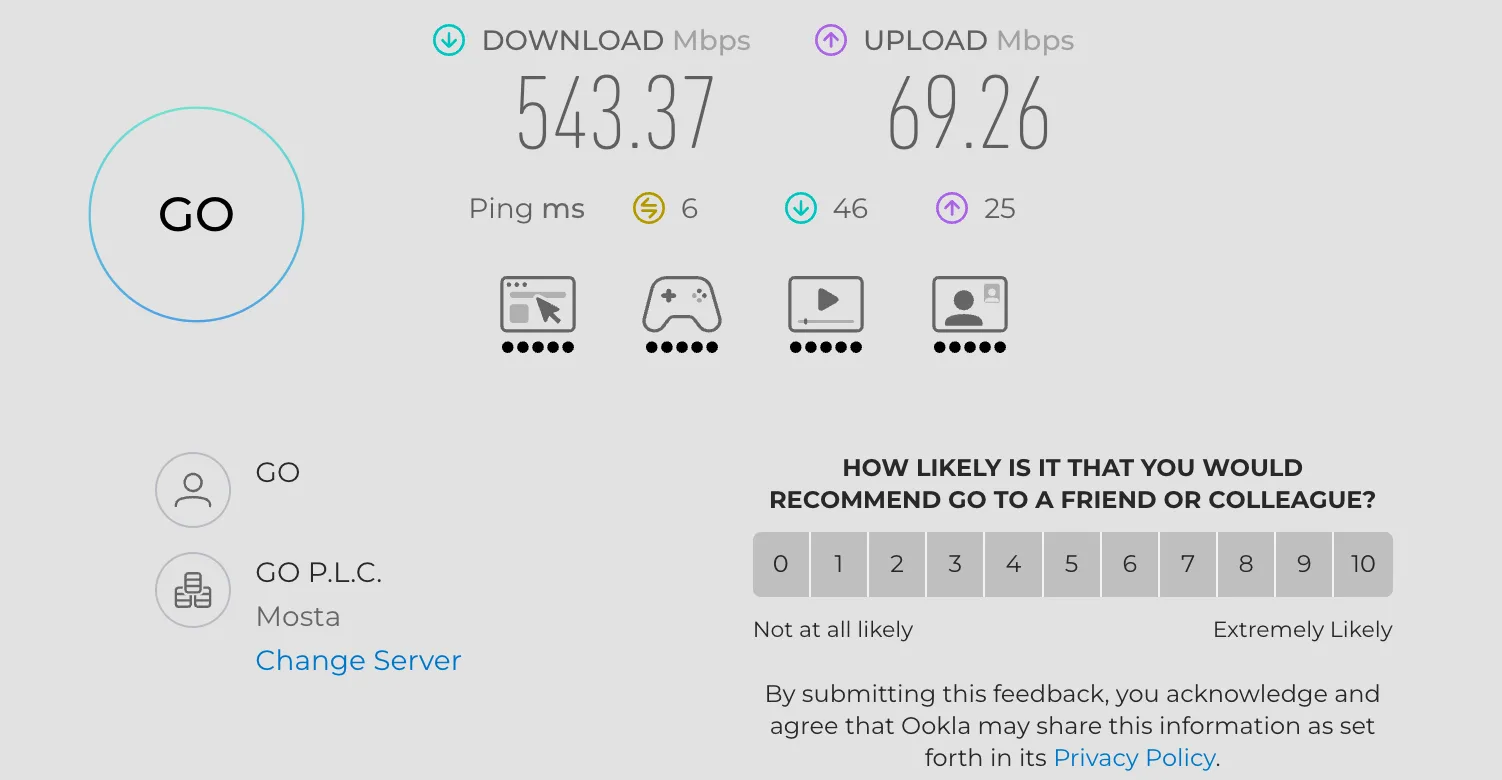
To put a real number on it: I'm on GO Max, GO's top home plan at about €50 a month, and the screenshot below is a test from my own flat. Note that I ran it over WiFi from the sofa, not plugged into the router, which is how most people actually use their connection, and it still clocks 543 Mbps down and 69 up with a 6 ms ping. Wire a laptop straight into the box and you'll get closer to the plan's ceiling, but 543 over WiFi is the number that matters for daily life, and in a year it has never once stuttered on a video call.
Melita's strength is apartment blocks. Because it grew out of the cable network, in a lot of older Sliema and St Julian's buildings Melita is already wired to the wall and GO fibre isn't. In that situation Melita is simply the practical choice, and its TV lineup is the biggest if you care about that. Watch for the one-off installation fee on some contracts.
Epic's home fibre is the newest and the cheapest at the top end, but coverage is patchier and it may not reach your street yet. If it does, and you're already using Epic mobile, bundling is tidy.
How much speed do you actually need?
Providers sell on the headline download number because it's the biggest, but it's rarely the number that decides whether you're happy.
For a single person or couple who browse, stream and take the odd video call, 100 Mbps is plenty and you'll never feel it straining. A household of two or three remote workers all on calls at once, plus 4K streaming in the evening, is comfortable on 250 Mbps. You only need gigabit if you regularly move very large files (video editors pulling raw footage, developers syncing huge repos) or if the extra few euros just doesn't bother you. Don't let a salesperson upsell you to 2.5 Gbps because the number sounds impressive.
The figure nobody advertises but remote workers should care about is upload speed. Video calls, cloud backups and screen-sharing all lean on upload, and Maltese plans cap it well below the download number, on fibre too. Don't assume; ask for the upload figure specifically before you sign.
One more practical point: the speed you pay for is the speed to your router, not the speed at your laptop across the flat. In a larger apartment or a maisonette, take the cheaper plan and spend €60-100 on a decent mesh WiFi system instead. A 250 Mbps plan through good WiFi beats a gigabit plan through the free router struggling to cover three rooms.
What my own line measures
Since this guide says "tested" on the tin: I'm on GO's top fibre tier in a St Julian's apartment, and measured over WiFi from where I work it delivers around 380-390 Mbps down, 42 Mbps up, with ~44 ms idle latency (Malta routes through mainland Europe, so latency in the 40s is normal here, and fine for calls).
That one measurement carries both lessons from above. The download is a fraction of the multi-gigabit headline because WiFi is the bottleneck, not the fibre, and day to day it makes zero difference, since nothing I do saturates 380 Mbps. And the upload sits at 42 Mbps on the fastest consumer plan GO sells, which is plenty for video calls but worth knowing before you sign if you push large files for a living.
The one rule that overrides all of the above
Check availability at your exact address before you fall in love with a plan. Every provider has a coverage checker on its site, and the reality of Maltese telecoms is that two flats on the same street can have different options. I've seen a friend set his heart on GO gigabit only to find his building was Melita-cable-only. Choose your flat first, check which providers reach it, then compare plans among the ones that do.
Which is the fastest internet in Malta?
On paper, Melita. Its fibre page advertises up to 2.5 Gbps and bills itself as the fastest fibre provider on the island, Epic's home page now announces a 3,000 Mbps tier, and GO's home internet page headlines 1,000 Mbps for its home packs (advertised speeds checked September 2026). Those are maximums for a cable plugged into the router, not what your laptop will see from the sofa.
In practice the fastest internet in Malta is whichever of the three has real fibre into your building, on the plan you actually use. My own GO line on the top tier measures around 380-390 Mbps down over WiFi from my desk, as described above, and that is the everyday ceiling in most flats: the last few metres of WiFi decide your speed, not the gigabit on the invoice. A 250 Mbps plan from any provider, wired properly, feels identical to a 2.5 Gbps plan for streaming, calls and normal work. And upload, which none of the headline figures mention, sits far below download on every plan, so ask for that number before you sign if you push big files for a living.
Fibre installation: what actually happens
Once you sign, here's the realistic timeline. A prepaid SIM is instant. A postpaid mobile line is same-day. Home internet depends entirely on whether your address is already wired.
If the previous tenant had fibre and the socket's on the wall, activation can be a few days; sometimes they just switch it on remotely. If it's a fresh install needing an engineer, budget one to two weeks and expect to take a morning off for the visit. This matches the wider Malta pattern where nothing official happens on your timeline: bank accounts, residence cards and internet all run on "a couple of weeks."
So order your home internet the same day you sign your lease, not the day you move in. That way the install slot is booked while you're still packing, and you bridge the gap on mobile data: a prepaid SIM with a big data bundle, or GO's Plug 'n' GO box, covers a fortnight without pain.
Ask about equipment up front. Router rental is usually included in the monthly price, but confirm it, and confirm whether you hand the router back when you leave (you do, and they'll charge you if you don't).
Contracts, cancellation and switching
Maltese telecom contracts are mostly 24 months, and the early-termination fees are the sting. From what I've seen and what the comparison sites report, breaking a home contract early can cost roughly €100-200 with GO, up to around €300 with Melita, and about €150 with Epic. Read the exit clause before you sign, especially if your stay in Malta is open-ended.
If you're not sure you'll be here in two years, ask specifically about 12-month or rolling options. Epic is the most flexible here; it often runs a 12-month home option and a short risk-free trial window. And if you do leave early, contracts can usually be transferred: plenty of people hand theirs to the next tenant or a friend rather than pay the penalty. Ask the provider how they handle a name change before you need it.
Switching provider and keeping your number
Number porting is your right, not a favour. The process is regulated by the Malta Communications Authority and it works the same way as in the rest of the EU: you sign up with the new provider, give them the number you want to keep, and they handle the transfer with your old provider. You don't have to call your old provider to beg permission, and a shop assistant telling you you'll lose your number is wrong. The port itself typically completes within a working day or two; your old SIM dies and the new one picks up the number.
Two practical notes. Porting doesn't cancel a contract: if you're mid-term on a 24-month deal, the termination fee still applies, so time the port for when the contract lapses. And keep the old SIM until the new one carries your number, because there's a brief window where neither works and you don't want to be mid-bank-verification when it happens.
What a real setup costs: three worked examples
Ranges are easy to nod along to, so here's what the table above adds up to for three typical situations. These are compositions of the verified prices earlier, not quotes.
Solo remote worker in a Gzira one-bed. A 250 Mbps fibre plan at ~€30 and an Epic Standard mobile at €13.50 promo (€29.99 after year one) lands you at ~€44 a month in year one, ~€60 after. If the flat happens to be Melita-wired, the internet-plus-Endless-mobile combo with the €5 bundle discount comes out around the same but without the year-two jump.
Couple, both working from home. One 250-500 Mbps line at ~€30-35 shared, plus two mobile plans at €13.50-25 each: roughly €57-85 a month depending on provider mix and promos. The second mobile line is where the Melita bundle discount or an Epic promo does its best work.
Language student or six-month stayer. No home contract at all: a €10-20 monthly prepaid top-up plan, school and café WiFi for study, tethering for the rest. €10-20 a month, total. If the flat has no usable WiFi, add a Plug 'n' GO box at ~€28 rather than signing anything with a termination fee.
Slot those into the wider budget picture in the Malta cost of living guide; telecoms are one of the few lines here that are cheaper than most of Western Europe.
Do you even need a TV package?
Both GO and Melita will bundle TV into your home package, and the salesperson will push it because it bumps the monthly price. Be realistic about whether you'll watch it: plenty of expats sign up for the full lineup, then realise three months later they've watched Netflix, a couple of streaming apps and precisely zero linear channels.
Where the TV bundle earns its keep is live sport and local content. If you want Premier League, Serie A, Champions League or the Maltese channels, a package from GO or Melita is the cleanest way to get them on a proper screen, and often cheaper bundled than as a standalone sports add-on. Melita historically carries the widest lineup thanks to its cable-TV roots. If you mostly stream on demand, take internet-only and put a cheap streaming stick on the telly. The maths favours streaming unless live sport is non-negotiable for you.
Short stays: tourists, house-hunters and digital nomads
Not everyone is signing a 24-month contract. If you're here for weeks rather than years, scouting the island before you commit, or nomading through for a season, you don't want home fibre at all.
A tourist eSIM is the least-hassle option for a short visit. You buy it online before you land, scan a QR code, and you have data the moment your phone wakes up at the airport. It costs more per gigabyte than a local prepaid SIM, but you skip the shop visit entirely. Fine for a week or two of maps and messaging.
A local prepaid SIM wins the moment you're staying longer than a few days. The €10-20 top-up plans from Epic, GO or Melita give you far more data per euro than a tourist eSIM, plus a real Maltese number. This is what I'd tell any house-hunter to grab on arrival.
A pocket WiFi device or GO's Plug 'n' GO box covers you if you need proper home-style internet in a short let with no fibre. Plug 'n' GO runs from around €28 a month with no installation, ideal for a month-long stay or the gap between signing a lease and getting fibre installed.
If you're staying long enough to work seriously but not long enough for a two-year contract, the sweet spot is a big-data prepaid SIM tethered to your laptop, or a month of Plug 'n' GO. Don't lock into a 24-month deal you'll pay to break.
Roaming and using your foreign plan in Malta
If you hold an EU or EEA SIM, it works in Malta under Roam Like At Home at no surcharge. That's been the rule since June 2017 and it's real: for a holiday or a scouting trip you need to do nothing at all.
Two catches for anyone staying longer. Roaming has a fair-use data cap, so heavy use on a foreign plan eventually gets throttled or billed. And a foreign number quietly marks you as not-quite-here; for banking, government portals, delivery apps and job hunting, a Maltese number is smoother. Non-EU arrivals (UK included, post-Brexit) should assume roaming will be expensive and get a local SIM on day one.
Going the other way, all three Maltese providers include EU roaming on their plans, and Melita's postpaid roaming allowance in particular stretches to the UK and USA. If you travel a lot, compare the roaming buckets, not just the home data.
Free WiFi around Malta
You're rarely stuck for a connection here. Free WiFi is standard in cafés, restaurants and shopping centres, along the Valletta and Sliema waterfronts, and at the airport, and many town squares carry free public hotspots under a government scheme. It's fine for maps and messaging; I wouldn't do banking on open public WiFi, but for coffee-shop browsing it does the job.
What about Gozo?
I assumed a small rural island would mean bad internet, and I was wrong. Both GO and Melita have rolled fibre across most of Gozo, and home speeds there match the main island, a real factor if you're tempted by Gozo's cheaper rents for remote work. Mobile coverage is solid too, with the usual caveat that a few rural hamlets and valley bottoms have weak spots. As everywhere in Malta, check your specific address. Getting between the islands is a separate puzzle I cover in the Malta-Gozo transport guide.
What you need to sign up
Barely anything, which is refreshing after dealing with Maltese banks. For a prepaid SIM you just need your passport or ID card. For a postpaid mobile or home contract you'll typically need a valid ID (passport or residence card), proof of address such as your rental contract, and a local payment method: a Maltese bank account or card for the direct debit, which is why sorting your banking early is worth it. Some providers accept a Revolut or foreign card in the meantime, so ask if your bank account is still weeks away.
So which provider should you actually pick?
Here's how I'd decide it, cutting through everything above.
Pick GO if you want the connection you never have to think about, your building has GO fibre, and reliability matters more than saving a few euros. It's the safe default and the one I'd choose for a family home or serious remote work.
Pick Melita if you're in an older apartment block where its cable already reaches, you want the biggest TV package, or you want home internet and mobile on one account for the €5 monthly discount. It's the value pick and often the only practical pick in certain buildings.
Pick Epic for your mobile line. It has the strongest data and roaming offer, and the promo prices are unbeatable as long as you diarise the month-13 price jump. Consider its home fibre only if it reaches your street and you like keeping everything under one roof.
For a lot of expats the tidiest setup ends up being Epic for mobile and GO or Melita for home internet, chosen by whatever's wired into the flat. There's no shame in mixing providers; the loyalty bundles rarely save enough to override picking the best network for each job.
And the rule that beats every recommendation in this guide: flat first, coverage check second, plan comparison last. Do it in that order and you'll be connected within days, at the right price, on a network that reaches your living room.
Written byVincent Ventalon
French software engineer living in St Julian's and running his company from Malta. This site is what I learned on the way.More about me